 Image credit: Tarique Sani (https://www.flickr.com/photos/tariquesani/6834426351/)
Image credit: Tarique Sani (https://www.flickr.com/photos/tariquesani/6834426351/)
In desperation, I decided to add a multi-label classification model as a preliminary filter. The idea was that if it was accurate, it could be used to eliminate most of the empty tiles, thereby greatly reducing the workload on the slow Detectron2 model. I chose a ResNet50 model from fastai, because a ResNet50 should be fast and fastai’s training environment is superb.
To make a longish story short, I created a new VM, installed the fastai environment, ported the training images, annotations and model file to the new environment, converted the annotations to the multi-label classification format, and trained the model, as described in 06_fastai_model.ipynb. It soon reached an acceptable level of accuracy (about the same as the Detectron2 model) and so I ran an initial batch of test images through the model. To my horror, inference took 0.37 seconds per image. Several desperate hours later, thanks to the wonderful fastai community I discovered a hidden parameter whose default was cpu=True in the function that re-loaded a saved model. In other words, it wasn’t using the GPU! I changed that to cpu=False and Hey Presto! It ran 150 X faster.
It was time to put the classification model to a more serious test. I ran a batch of 20,000 full-size images from a study site that the model had never seen before. Because I hadn’t yet figured out how to pass in-memory tiles to a fastaidataloader, I wrote just over 1 million tiles (20,000 X 54) to disk. That tiling took nearly 12 hours, which is a problem, but I was very relieved to find that it took less than 2 hours to run 1 million tiles through the model on an Azure NC6_v3 machine (which has an Nvidia V100 GPU). Finally, we had a model that was fast enough to be really useful! But was it accurate enough?
The standard ‘confusion table’ method for assessing the output of a single-label classification model does not work in the multi-label case. In a multi-label model, you never know whether an object was missed (not detected at all), or misclassified (detected, but classified as the wrong category). I haven’t found a good way to assess a multi-label model, but I wrote some code to try to separate missed from misclassified objects, as shown in the . In the process, I discovered two surprising edge cases: 1) Some tiles were not classified as anything. No category including the ‘empty’ category had a score that was higher than the detection threshold. I named these predictions ‘uncertain’. 2) A few tiles were classified as both empty and as containing an object. That wasn’t really a problem because we could just ignore the ‘empty’ classification in these cases.
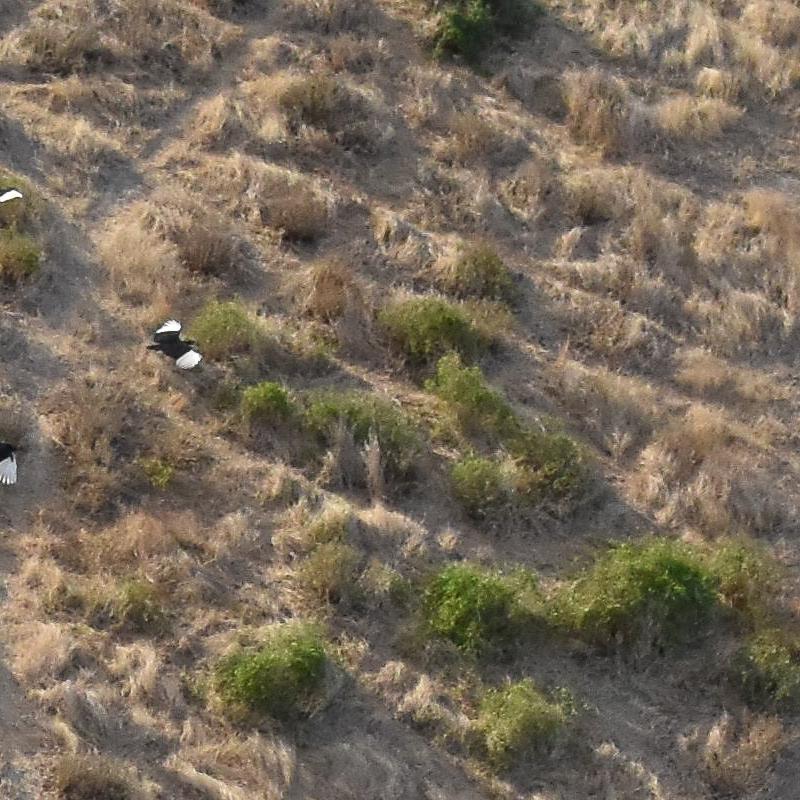
This is a ground hornbill, flying. The model recognized that it didn’t belong to any of the categories it knew, but it also didn’t look like an empty tile, so none of the category scores passed the detection threshold. As a result, our rules classified the tile as “uncertain”.
Clearly, the fastai model’s empty’ category is not just a remainder that is created when the model fails to find any object in an image; it’s actually a learned category itself. That architectural choice generates the strange edge cases that make counting results much harder. But is it a bug or a feature?
We examined the ‘uncertain’ tiles and discovered that in many cases, there were interesting objects in them; sometimes objects that were not in our list, and other times false-positives. Essentially, the ‘uncertain’ category is quite useful because it highlights images where ‘something is not quite right,’ and we therefore decided to treat it as a feature, not a bug. As our model improves (particularly for rare categories), we expect that the number of ‘uncertain’ predictions will shrink, but they will still highlight tiles that are worth examining more closely.